
Calving Season: When Waiting Makes Us Reach for a Golden Calf

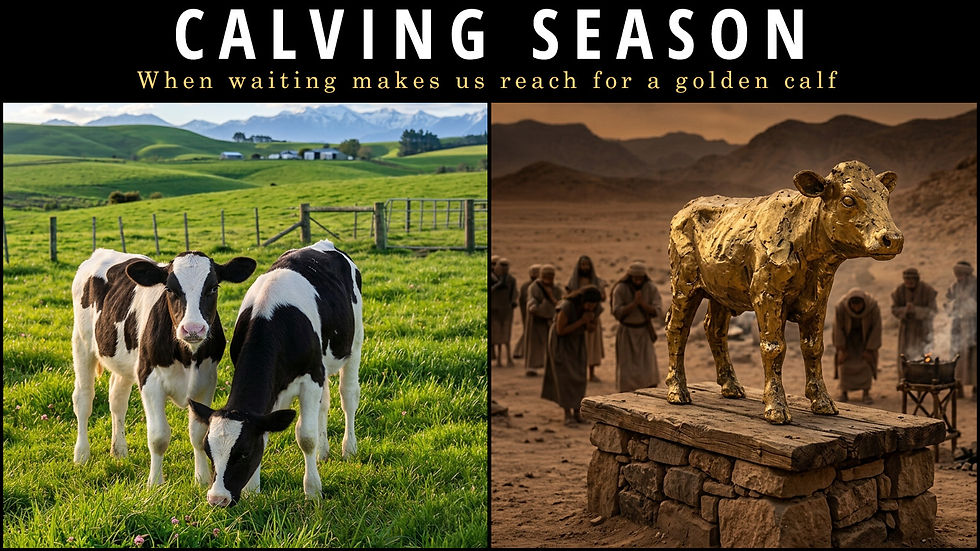
New Zealand spring has its own soundtrack: lambs and calves calling across paddocks, birdsong returning, rain on fresh grass, and the quiet persistence of new life. It is calving season.
That made Anthony Dady’s sermon title especially memorable today: “Calving Season.” His text was Exodus 32:1–14 — the troubling account of Israel’s golden calf. The contrast could not be sharper. A newborn calf is a sign of life received as gift. Israel’s golden calf was an object made by human hands, born from anxiety and impatience.
Moses had been on the mountain for a long time. The people did not know what had happened to him, and uncertainty became unbearable. They wanted something visible, something they could point to, something they could manage. Aaron helped them turn their gold into an image and then attempted to attach worship of the Lord to it.
Idolatry occurs when we ask something finite and manageable to give us what God alone can give.
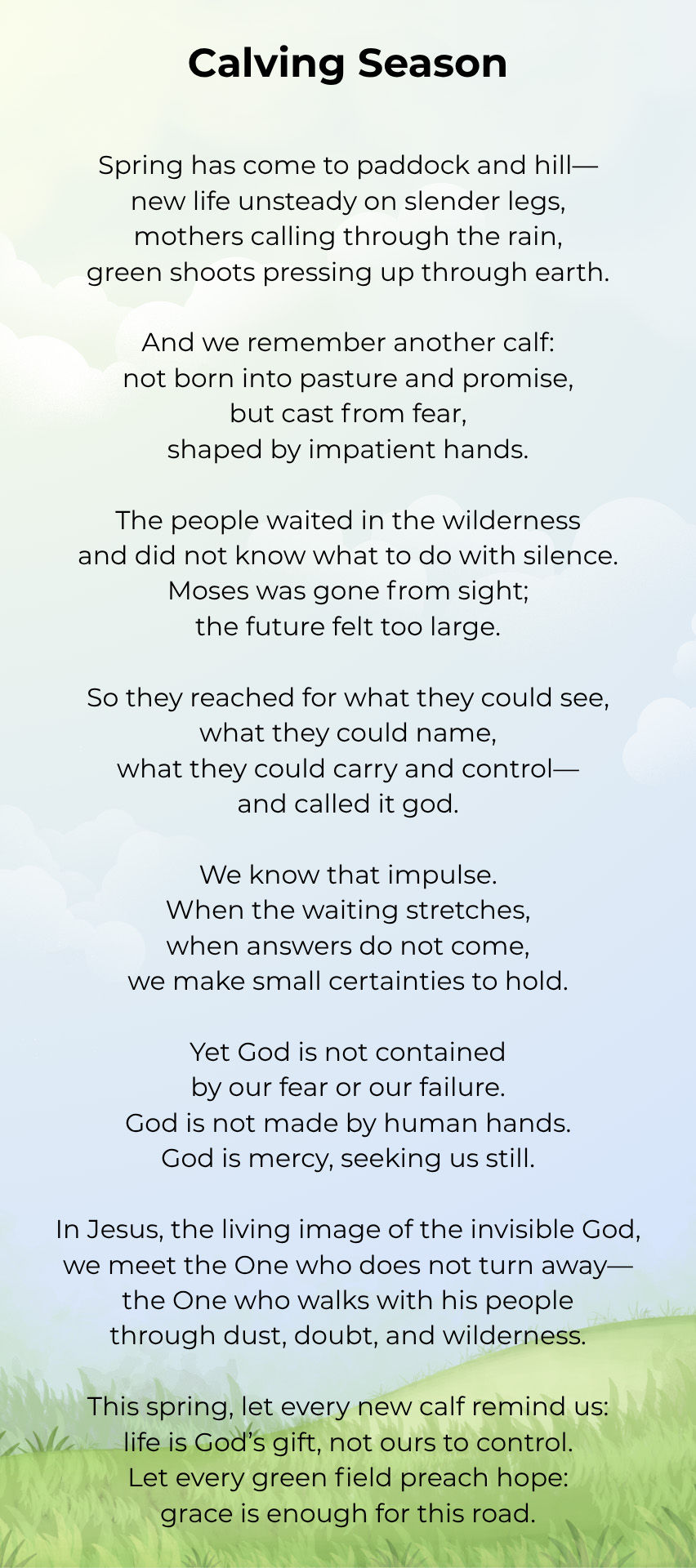
The temptation was not simply to reject God. It was to reduce God—to reshape the living, free, and relational God into something controllable. The GCI sermon resource expresses the central challenge clearly: idolatry occurs when we ask something finite and manageable to give us what God alone can give.
That temptation remains close to home. In times of delay, grief, uncertainty, or change, we may be tempted to make an idol of certainty, success, a political identity, a leader, a religious formula, or even our own understanding of God. Such things can become “golden calves” when we treat them as ultimate and refuse to let Jesus question them.
Yet Exodus 32 does not leave us only with Israel’s failure. Moses intercedes, appealing to God’s covenant faithfulness. The story points us toward the mercy of God—a mercy ultimately revealed in Jesus Christ. Jesus is not an image we have fashioned; he is the living image of the invisible God. He shows us who God is and brings humanity into the faithful relationship with the Father that we could not create for ourselves.
This is where the song O povo de Deus (The People of God) offers a helpful companion. Its pilgrimage imagery names a truth we know: God’s people walk through wilderness, sometimes falter, sometimes struggle to trust love, and still find grace enough to start again. The World Council of Churches includes the song in its Hosanna! collection of songs for justice and peace.
During this spring season, perhaps the invitation is simple: receive life as gift, release what you are trying to control, and look again to Jesus. The God who called Israel is not limited by human confusion or failure. God is faithful, merciful, and present with his people on the road.
Let's think about Calving Season: When waiting makes us reach for a golden calf...and how our response should change.

Comments